Transcript
Audio Clip: By late morning, it was clear. June 6th would be no ordinary Friday in LA.
Michael Fox: June 6th, 2025. Ice officers raid a garment factory in downtown Los Angeles. There’s another raid at a Home Depot. They detained dozens of people. The same day Los Angeles explodes in protests in response. They ripple across the city for more than a week. The first big response to the immigration crackdown in Trump’s second term. Photojournalist Nick Stern was there.
Nick Stern: I’ve been a photojournalist for around 30 years initially in the UK and 2007, I moved to the US and became a citizen in 2019.
Michael Fox: I spoke with him recently. He’s worked in 50 countries covering stuff like this, big protests, civil unrest. So June 6th last year, Nick said the protest was loud, noisy.
Nick Stern: I got pepper sprayed, pepper gassed in my face, which was pretty horrific.
Michael Fox: The next day is a Saturday. There are more ice raids and a big protest that carries into the evening, Nick’s back on the streets and he’s there throughout the day.
Nick Stern: It was a Saturday. It was June the 7th and it was about 10 to 90 in the evening.
Michael Fox: He told me there were a few stragglers in the protest. He was off to the side, kind of parallel with the police. And you can even see this in some cell phone footage shot and posted online from that night. Suddenly an officer turns and fires at him with a less lethal projectile.
Nick Stern: What’s called a flashbang, which is an explosive, which embedded in my right thigh.
Michael Fox: In this video, he kind of limps off the street. People rush to help him as he drops to the ground. There’s blood pouring from his leg and he’s rushed to the hospital and has to undergo emergency surgery. They kept him there for four days.
Nick Stern: And I still get pain in my leg. That device was, again, 40 millimeter and about two inches long, so a pretty sizeable munition embedded in my leg.
Michael Fox: He said at first they were actually afraid it was going to explode inside his leg. He said in the hospital during those days he had to miss his son’s graduation from high school. He had these flashbacks and nightmares almost every night that still haven’t completely gone away and he’s had to have months of treatment in particular for PTSD.
Nick Stern: I was doing a video interview for a documentary in London and when the director asked me to explain what happened at the incident, I did in sensory terms, explaining what it felt like, what it hurt, what the air smelled like and what sounds were going on. And as I was describing to him, I broke down crying and I haven’t cried for many, many years and it was pretty much uncontrollable. When I got back to the US, I thought that I really should go and see somebody and I was diagnosed by three professionals as having post-traumatic stress disorder, PTSD.
Michael Fox: Over the last year, he’s still living with repercussions. He still has nightmares two or three days a week and this PTSD induced anger, which he never felt this way before.
Nick Stern: Fuck, I’ve never been angry at anything, but having this PTSD related anger, I feel like a bottle of soda that’s been shaken up with a cap that’s ready to be released.
Michael Fox: And the thing is, this is just one story, one experience.
Nick Stern: I’m one of dozens of journalists in Los Angeles. Every single one has been brutalized, assaulted, detained, or arrested by LAPD. And that is not just journalists. Obviously that is happening to members of the public as well. Yeah, I don’t think I know of a single journalist here in Los Angeles who hasn’t been hit by less lethal. And whilst the first time it happens to you, it’s, “Oh, I’ve been hit.” It’s almost, what the fuck? It’s almost become the normal here. We expect to be hit with less lethals now when we’re out there covering protests. But there are journalists who have been violently pushed down who like me who have been knocked down by horses who have been hit with less lethals, who have been hit with buttons and having fingers broken, finger smashed open, rigs, cracked, wrists broken and so on. And these are all people identified as journalists.
Michael Fox: And of course, this didn’t just start with Trump. Police violence against protest has been heavy-handed for years, decades. Trump’s discourse now and also in his first term though, legitimizes the harsh actions by law enforcement.
Nick Stern: So I think that law enforcement feel they have a get out of jail free card with this administration and that’s trickling down through the whole system.
Michael Fox: And here’s the thing that Nick Stern told me in particular about this protest. And like I said, he’s been on the streets covering it for 20 years in Los Angeles. He said this was the first time he had seen this level of militarization of law enforcement.
Nick Stern: That was quite a shocking sight to see in the US, supposedly one of the most wealthiest civilized countries in the world with one of the best supposed democracies that we have. So firstly, the vision, the sight of these troops and military vehicles on the street was quite shocking, but also the way in which they were reacting. Some of the places I’ve been, some of the civil unrest I’ve seen, you will see this kind of action from military forces, but that is when there is a potential civil war or an uprising or something similar to that, not what is considered to be initially a peaceful protest. Well, I have to be honest with you, Michael, what I’m seeing here is probably worse than I’ve seen in many other countries around the world. I’ve worked in Eastern Europe where you have obviously very authoritarian or you did have very authoritarian governments and secret police and so on.
And what we’re seeing here on the streets is possibly worse than that in terms of the conduct of law enforcement, the strategy of law enforcement and the lack of accountability, I think, as well.
Michael Fox: And for me, what’s so concerning is that this is just the tip of the iceberg in terms of the attacks on journalism and the assault on press freedom today in the United States. This is The Battle for Free Speech, a multi-part narrative podcast brought to you by The Real News. In this series, we take you on a journey to understand the important role free speech has played in US history and the fight being waged over it today. I’m your co-host, Michael Fox, and I’m so excited to be joined today by Taya Graham. She’s an investigative journalist and a Capitol Hill correspondent with the Real News. She’s also the co-host of The Real News’ Inequality Watch and the Police Accountability Report. Teya, thank you so, so, so much.
Taya Graham: Oh, it’s an absolute pleasure to be here. Thank you for having me, Michael.
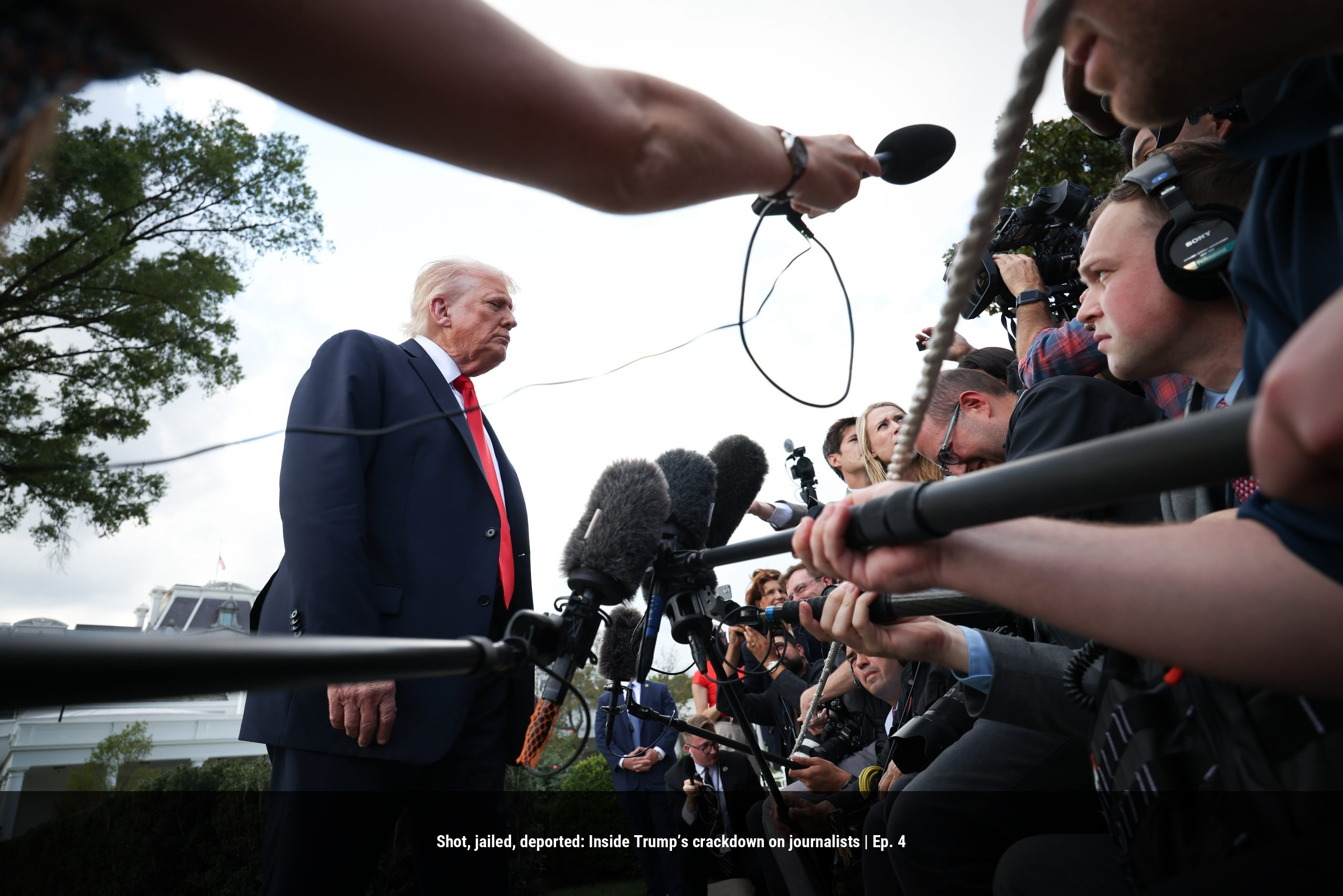
Michael Fox: Of course. Folks, if you’ve been listening to this podcast series from the beginning, then you probably know how it works. I go out, I do a ton of reporting, bring that all back for us to discuss and this episode is no different. So today we’re going to focus the entire time on press freedom and the attacks on the press, particularly under the Trump administration. And I want to start where we left off at the top and put some context into what we heard from Nick Stern. So a few days ago I dug into the US Press Freedom Tracker. It’s an incredible online source from the freedom of the Press Foundation. It essentially tracks cases of attacks on press freedom in the US. According to the tracker, last year there were 195 assaults on journalists, most of them by law enforcement. And just to put that into perspective, that’s about double the number from 2024 before Trump’s second term and four times what it was in 2022 and 2023.
Taya Graham: Incredible.
Michael Fox: Now to be clear, it was even higher in 2020. Remember that was the Black Lives Matter protests, so things just exploded through the roof, but then that was also during Trump’s, that was during his first term. But this year as of mid-June, we’re on pace to break last year’s figures. There have been more than a hundred assaults on journalists, more than 30 arrests and numerous cases of equipment damage or seized and other incidents. Teya, you’ve covered police brutality a ton. What have you seen? How do violence violations against journalists fit into that? Have you seen an uptick of assaults and violations against the press in recent years or under the Trump administrations?
Taya Graham: Oh, I’ve definitely seen an uptick in assaults against journalists. I mean, that absolutely is beyond a shadow of a doubt, but I’ve also seen it against members of the public as well also exercising their First Amendment rights. And one thing I just want people who are listening to know your average journalist, when they sign up for this job, it’s because it’s a calling. It’s because it’s a vocation. And we already know that we’re willing to go to jail for a source. We already know that. We’re going to protect that whistleblower that is helping us do that investigation. What a lot of us aren’t prepared for though is being shot in the face with a rubber bullet and being blinded in one eye or being put in jail for days at a time and no one being able to know where you are. That is something that a lot of us weren’t prepared for because we thought we were in the United States land of the free.
Michael Fox: So important because it’s a reality and I don’t think people understand just how deep that reality goes and how much journalists have their back against the wall and how difficult this moment is because there’s so many things like you can read, oh, a journalist gets arrested or a journalist is assaulted, but there’s so many other layers, which we’re going to get into in today’s podcast, but there’s so many other layers of things that have to happen in order for all that to get pushed to the side. And like what we heard from Nick Stern at the very top, it’s a year later and he’s still suffering the consequences of being shot with a less lethal in the leg. I want to take a step back a little bit.
Audio Clip: Reporters Without Borders is warning press freedom has fallen to its lowest level since the group began publishing its annual World Press Freedom Index 25 years ago.
Michael Fox: It was shocking to me when in late April I saw the announcement that press freedom around the world was at a 25 year low and that the United States had dropped to 64th on the World Press Freedom Index. I mean, I don’t even have words to describe what this is. So just so people understand, the World Press Freedom Index is released from the group reporters without borders every year. They’ve been doing it for the last 25 years. They judge on five criteria, legal, security, political, social, and economic issues relating to press freedom. But in all of this, the United States is not doing well, 64th in the world. And Teya, just to give you a little context, so that’s seven countries lower than it was last year. Also, according to the index, the United States is now rated a “problematic” country with quote significant constraints on press freedom and where “self censorship is common.” The United States now ranks below Botswana, Mauritania, even Ukraine, the ivory coast and it’s a whole 12 points back from Brazil
Taya Graham: Incredible
Michael Fox: Now it’s been backsliding for years. When Reporters Without Borders first began to publish this, it was at number 17 so it’s fallen 47 spots since then and this huge drop clearly over the last year is directly related to the Trump administration and Trump pulling out all the stops to try and control the quote information environment in the United States today. Teya, you’re like on the ground in Washington, you’re on the ground in Baltimore. I feel like people are going on with their lives. People are getting more and less and less news from outlets. They’re getting more and more stuff from social media and you never know if it’s real or not. How are you seeing this transformation happening on the ground?
Taya Graham: Well, I agree with you that the Trump administration should not be underestimated in the role that they have played in lowering us on that list of press freedom. But one thing that I’ve noticed as a reporter on the ground watching the industry itself is that if we don’t acknowledge the role that capitalism is playing, we’re doing ourselves a real disservice here because there has been unprecedented consolidation, but what happens is with this media consolidation, you have owners that are now billionaires with their own particular political views that are pressing down from the top onto the journalists. Journalists have to worry about getting access. If you criticize the wrong politician a litle too loudly, you’ve now lost access, whether that’s to the Oval Office or to your local city hall. So there’s access, there’s making sure that you don’t lose advertisers, there’s making sure that you don’t make the shareholders unhappy.
So what ends up happening for, because I think someone needs to talk about what’s happening to reporters. They are getting squeezed on all sides just through the consolidation process and the overall downsizing that’s happening because as it consolidates, the number of jobs decreases so reporters are losing their jobs. As a matter of fact, local press is dying so many small newspapers and websites are being shut down, which means people aren’t going to get information. And one thing I always tell people when they have a little bit of distrust around the press, I say, “You know what? Be glad someone like me is showing up at City Hall because if you think your politicians are behaving badly while I’m watching, guess what they’re going to do when I’m not watching?” That’s right. Okay. You do need us folks on the ground.
Michael Fox: That’s right. Throughout the lawsuits and the harassments and the attacks, the detentions, the deportations against journalists that we’re seeing from the government, the end of the day, the real goal is self-censorship. Absolutely. The real goal is to make people afraid so they will not speak out and that’s not just for the press. I mean, we’ve seen that in the last couple of episodes in this podcast already where the Trump administration is pushing against anybody it possibly can in order to try and force them to not speak out.
Taya Graham: Absolutely.
Michael Fox: Tay, I want to bring in someone here.
Katherine Jacob…: My name is Katherine Jacobson and I’m the US Canada and Caribbean program coordinator at the Committee to Protect Journalists.
Michael Fox: And I feel like her analysis is really, really important because they’re out there day after day standing up for journalists and trying to analyze what’s happening on the front lines. And she basically says that for the free press community, the second Trump administration is pretty much a worst case scenario.
Katherine Jacob…: We’re talking about regular lawsuits being launched against news media outlets, both from the sitting president of the United States, which is absurd to think about, right, but yet happening as well as his associates when they don’t like the reporting. We’re also seeing federal communications commissions and other regulatory bodies being used or the administration trying to use them in novel ways, really pushing the bounds of what these regulatory institutions are supposed to be doing to try and shape coverage.
Audio Clip: CBS is no good. And in fact, in honor of you, I just sued CBS today because of 60 Minutes.
Michael Fox: I just want to give some numbers here. So Trump has filed nine different lawsuits against media outlets since 2020. He’s demanded billions of dollars for damages for what he says are false or misleading reports. A judge throughout the latest just in April, Trump had sued the Wall Street Journal for $10 billion for defamation for a story about a birthday letter from Trump to Jeffrey Epstein But this gets into kind of what you were just mentioning to you. The reality is that it doesn’t matter if Trump’s lawsuits are legitimate or not. The idea is to attack his opponents, divert the attention and make them cough up millions of dollars in legal fees and of course scare these media outlets and their journalists away from reporting critically against Trump and his government.
Katherine Jacob…: Yeah. The lawsuits that we’re currently seeing from the Trump administration and his associates such as Cash Patel really seem like they are being deployed to silence coverage or intimidate journalists from covering certain topics, right from reporting critically on this administration. However, merely filing these lawsuits creates both an expensive and time consuming distraction from what these outlets should be doing.
Taya Graham: It’s terrifying because on multiple levels he is intimidating not just journalists, but the people that journalists rely on. There are people in the government who are whistleblowers, who are sources. And you have seen, for example, how Secretary Hecseth has gone out of his way to try to pursue any leaks to the point where I believe he’s actually giving lie detector tests to people who worked underneath him. So this lets you know that they are incredibly serious about preventing anyone from within the government to speaking to people in the press and that’s actually something that has to happen that we don’t have a pair of magical binoculars that allows us to see inside. We have to have whistleblowers. We have to have people willing to speak to us so we can let people know what’s really going on behind the scenes. And so understandably, if you’re seeing reporters jailed, if you’re seeing reporters being taken into court, if you see reporters having their phones taken away, I believe it was a reporter at the Washington Post who had her entire house raided, had her phones taken, had her computer taken.
Wouldn’t you be worried to speak to that next Washington Post reporter who says, “It’s okay, you can give me this information?” Well, how do I know they won’t find out it’s me? How do I know my contact information is going to be protected?
Audio Clip: The FBI has raided the home of a Washington Post journalist who’s been covering the Trump administration’s federal government firing since he took office.
Michael Fox: The woman that you mentioned, the Washington Post reporter, Hannah Natinson, and it was mid-January when the FBI searched her home, Northern Virginia home. They seized her watch a phone, two laptop computers. Now agents said, “Oh, we’re not after you. That’s not the focus of the investigation. You haven’t done anything wrong.” But the problem is just like what you just said, it’s chilling because someone just raided her home. FBI agents go in, they seize things, she knows they’re seeing all the documents. They said what they were really after was classified information that a source inside the Pentagon contractor had passed her. But what it really does is exactly what you were just saying, Teya, is it sends this message to other people within the Pentagon. “Don’t talk to the press, talk to the press and there will be repercussions.
Taya Graham: Absolutely.
Michael Fox: Taya, I have a little quiz for you.
Taya Graham: Oh, no. No, pop quiz.
Michael Fox: It’s okay. Pop quiz. I would not have gotten this either and it’s related to Trump’s lawsuits against media organizations. When do you think was the last time that a sitting president or any president for that matter sued a media outlet for defamation or libel?
Taya Graham: Okay. My guess would be potential … I know there was some issue with President Obama and Fox News and so I was thinking there might have been some kerfuffle there, but in all honesty, no, I’m not sure.
Michael Fox: It’s a little bit further back. It’s okay. I would never have guessed this either. 1912. Oh my God. Teddy Roosevelt, he sued against an editorial in a small weekly in Michigan’s upper peninsula, which called him a liar and a drunk. 1912. And of course, Trump is a big fan of Teddy Roosevelt. Remember this is the president who had the motto, walk softly and carry a big stick. So Trump likes this guy, but still we’re talking about more than 110 years ago. That was the last time that you had a president actually suing media outlets and now it’s happening all the time, plus Kash Padell and all the other folks.
Taya Graham: I thought you were going to drag out the sedition act. I’m like, are we going back to
Michael Fox: The
Taya Graham: 1700s or what?
Michael Fox: We could. We’ve talked about it in past episodes. It’s crazy that it’s like, no, it’s crazy that we actually have to be even talking about this. I mean, seriously, this is like, we should not have to talk about this in 2026.
Taya Graham: Very true.
Michael Fox: But it’s not just about the lawsuits. And this is something that as I’ve been digging into this episode has also been just shocking for me because the other thing that we see from Trump is this other level of attacking journalists, harassment, attacks in the press, in particular during press conferences and particularly against female journalists. Oh, yes. It’s shocking and relentless. And I was just watching some of the videos recently. He calls them names, he calls women journalists stupid.
Speaker 7: Well, if you knew anything about what you were talking about, you do? I don’t think- Did you just tell you that? You said that it was up to secretary heads. Obnoxious reporter in the whole place. Are you stupid? Are you a stupid person? But with a corrupt reporter standing right there. Never smile. She never switches. Who are you with? I’m with ABC. You’re with who? ABC News, sir. Fakeners. ABC fake news.
Taya Graham: Low IQ is one that he often likes to use for African-American female journalists. Actually, I’m still stunned when I think back to the National Association of Black Journalists, and I believe they had the Black journalist from Fox there, but they also had the lovely Rachel Scott and he was so incredibly rude to her, blamed her for a bit of trouble with the audio equipment, called her stupid, called her low IQ, called her an idiot. And this is just commonplace. I think recently he told a reporter quiet, Piggy.
Michael Fox: Teya, what is Trump trying to do, do you think, with his just constant verbal assaults in particular against women? What is his goal, his end goal there?
Taya Graham: I think to some people who support President Trump who voted for him two and three times, I think they see his bullishness, his willingness to attack as a sign of strength. I think that’s how he perceives it and I think that’s how some of the people who support and perceive it. Look at him giving it to those elites. Look at him saying what he really thinks. But in general, I think it is to sow a baseline disrespect and distrust for the media to say, “If the president doesn’t respect you, why should I? If he doesn’t listen to you, why should I? Why should I trust anything you have to say? My president just said you’re dumb and stupid and a liar and so is your organization. Why should I trust you? ” So I think it’s part of his larger movement to say, “Don’t trust anyone’s voice but
Michael Fox: Mine.” Trump is doing the same thing online, right? He makes these attacks over social media as well. This is something that the CPJs, Catherine Jacobson also said.
Katherine Jacob…: When you have the leader of the free world lobbying attacks on a social media platform, which he owns by the way, against the media because he doesn’t like coverage, if that’s on a dog whistle, I’m not sure what is. That really creates a permission structure for other individuals to go after journalists when they don’t like their reporting or to take other actions. Should also mention that the majority of online harassment is against women and journalists of color and journalists with non-traditional sexual orientations. And so you think about those traditionally marginalized voices that are being targeted and silenced and we really lose part of the, I think, strength of having plurality in media and having different voices and different points of view reporting on the news and what’s happening.
Michael Fox: And of course that’s the goal. The goal is to ensure that the public is les informed. That’s why this is happening right now. You don’t want more transparency in the Pentagon. The idea right now is to make sure that there is absolutely zero transparency so they can do whatever they want, right?
Taya Graham: Absolutely. And this lack of transparency is going to be enhanced by the fact that right now with the media consolidations that have been taking place, there are essentially media organizations waiting on Bend and for President Trump to give approval for their merger to go through. And these are billions and billions and billions of dollars that are on the line. So essentially President Trump is selling his influence and selling the benefit of his influence. If you give me loyalty, if you publicly demonstrate respect, if you say the things I want to hear, then things will go smoothly for you. So it’s an extreme form of influence peddling. And unfortunately, some of these billionaires just seem to get right on board. I mean, whether it’s Jeff Bezos in the Washington Post or David Ellison trying to do his Paramount Skydance deal or you know what? Even Ela Musk.
I mean, even though every once in a while various drugs will kick in and he’ll say something saucy to the president on social media. In general, he had taken what was an imperfect town square and made it into a pay for place site where you got to pay for your blue check if you want any chance of your tweets being seen and has turned it into a racist bot wasteland.
Michael Fox: Yeah, absolutely. I want to tell you a story. We’re going to visit Minneapolis, Minnesota right now. And we talked a litle bit earlier about FBI raiding a Washington Post journalist house confiscating, seizing her equipment, but we’re also seeing press being taken to jail for their reporting. And this is exactly what happened to the Emmy Award-winning journalist, Georgia Fort. She’s also the vice president of the Minnesota chapter of the National Association of Black Journalists. And so imagine this scene. It’s early morning, January 30th, cold outside Minneapolis, Minnesota. Snow is on the ground. Remember at this moment, Minnesota has been on fire for weeks after ice raids and protests and the killing of US citizens, Renee Goode and Alex Priddy. Georgia Fort is in her home and police are at her door. She goes live to thousands of followers
Audio Clip: Agents are at my door right now. They’re saying that they were able to go before a grand jury sometime, I guess, in the last 24 hours and that they have a warrant for my arrest. I’ve talked to my attorney and I’m being advised to go with them, I guess down to Whipple.
Michael Fox: It’s a chilling video and at one moment you can see the police actually outside.
Audio Clip: And my children are here. They’re impacted by this. This is all stemming from the fact that I filmed a protest as a member of the media.
Michael Fox: And when I watched this, Taya, I imagine myself in her shoes, right As the police are arriving at your home, what that means for me, what that means for my family, for my kids, they’re there to cart you off to jail for doing your job. It seriously seems like something out of a dictatorship, out of authoritarian government. The secret police are coming to round you up for speaking the truth. So they take Georgia Fort to jail. She’s arrested along with the former CNN anchor, Don Lemon on federal felony charges and they’re arrested for violating two laws. The first one, 1871, originally designed to combat the Klu Klux Klan and the other one is a 1994 law written to protect abortion clinics but which also prohibits interfering with religious worship. And the reason why this is happening is because earlier that month, January 18th, they’d covered and live streamed an anti-ICE protest inside of a church where one of the pastors was also an ICE field agency.
Audio Clip: All right if you guys are just joining us. I am here in St. Paul in the brutal cold at a church on a summit where as you heard from organizers, the pastor is in acting leadership position of ICE.
Michael Fox: So they were just doing their job. The video is still online and they’re talking to the people. They even speak with another pastor and yet within two weeks they were rounded up as well as several other people who had actually participated in the protest. People were clearly livid. People hear about her arrest. Holagues come out, they denounce it, they hold a protest.
Audio Clip: Georgia Fort is in federal custody for doing her job. One of the scariest moments of my life and in my career to know that a fellow journalist, a top journalist, an award winning journalist is right now sitting in federal custody for doing her duty. And if we leave here with anything today, let’s leave here making sure that the main thing stays the main thing. Journalism is under attack. The first amendment is under attack and democracy is crumbling. Yes.
Michael Fox: She was released later that day on bail. And as was Don Lemon and she was greeted by supporters and spoke to the press.
Audio Clip: As I reflect as a journalist who has worked in media for more than 17 years, I leave this federal courthouse today with one question. Do we have a constitution?
Or not?
Michael Fox: It’s just this one example, her case again, just like Nick Stern, just like so many other people we’ve talked about. It’s one example, but here again, the goal is to chill speech, to scare reporters,
To restrict critical reporting what people are covering. And it’s so important to understand kind of what’s not just what happens to her, but what happens later on. Because just last month there was a report that came out that she says she’s still being silenced. See, Fort is one of dozens of co-defendants arrested after that church protest. And since many of those people who were arrested are prominent community leaders since they were arrested there and the legal cases are ongoing, it means that her lawyers, Georgia Ford’s lawyers, have said that speaking with them might put her own case in jeopardy. And so it means that she has to deal with the legal fees, she has to deal with the time, but she can’t also speak with her sources. And those community leaders, I mean, you know as a community journalist, like this is everything. These are your sources.
These are your people you go to, but now she can’t even reach back out to them because they’re also members of the same lawsuit.
Taya Graham: I see what you’re saying.
Michael Fox: These arrests, these attacks, all of it kind of takes time out away from your journalism. All of it kind of pushes you away from focusing on the real issues that are there.
Audio Clip: Do we have a constitution? That is the pressing question that should be on the front of everyone’s minds.
Michael Fox: Taya, it is very clear that there are two issues that this administration really cares about.
Katherine Jacob…: I think at the very beginning it was campus protests and coverage of the campus protests. I’m of course referring to the Israel Gaza War and students protesting against that.
Michael Fox: This kind of came out a litle bit when I was speaking with the CPJ’s Catherine Jacobson. She dug into this a litle bit more. That
Katherine Jacob…: Was the initial tripwire issue and now we’re also seeing immigration being added to that and that I think the issues around immigration and customs enforcement actions and Department of Homeland Security more broadly and the way that individuals are being detained by ICE and other DHS agents on American streets without warrant.
Michael Fox: And she said we’re seeing this slow shrinking space for free speech specifically around these two issues.
And I think this is interesting because things happen all the time and we see them and the news goes and we don’t always put all the pieces together. But even just the people that we’ve been talking about right now, you see Nick Stern was shot covering the anti-immigration protests. Georgia Fort and Don Lemon were jailed for covering ICE protests. Most of the assaults and the arrests on journalists over the last year have all happened during the ice raids or the protests against the immigration crackdown. And that’s for journalists, but the stakes are even higher for immigrant journalists that are covering these things. Teya, I want to tell you a story that really underscores this. Mario Gebara. He’s a journalist who fled El Salvador in 2004 with his family due to political persecution. He moved to Atlanta, Georgia. He became a resident. He worked in media.
He’s been a journalist for Spanish language outlets in 2024. He founded his own outlet, MG News. He is legally, or he was legally in the country with a work visa, though he had filed for a green card. And in recent years, he has been laser focused on immigration, in particular covering the ice raids in the Atlanta region.
And Tea, his stuff is really local, really community-based and really good. So a bunch of his videos from earlier this year show him in his car. He’s gotten a tip that ICE agents are out and about and he goes to document and to advise the immigrant community, what’s happening? Where are people? What do you need to do? Where should you not go? He tries to identify those who have been detained. So in one video, he kind of gets out of his car and goes to a truck that’s just sitting there because the people who are inside the truck have been detained and arrested by ICE Asians. He goes to the home of Latino community members who have been picked up by ice. He talks to the families. So it’s powerful solid journalism, the journalism that we absolutely need right now, imperative journalism. And he’s doing it for the immigrant community that really, this is the place that it really matters.
In one video, he’s talking to his followers and he says that by recording these lives, he’s letting people know about the raids that are being carried out by federal officers so that people can know the truth so they know what’s happening around them. A couple of people respond in this one live that he did saying, “Well, they’re afraid of you. ” He says, “They’re not afraid of me, but they’re afraid of being filmed. They don’t like being on camera, but they’re not afraid of me. I’m just another guy. I’m another journalist.” Anyway, fast forward to June 14th, 2025.
Speaker 9: There’ve been rallies across the country opposing President Trump’s agenda on the day of the president’s military parade. They cap a week of demonstrations against immigration raids that began in Los Angeles and spread nationwide. Today-
Michael Fox: This is the day of the first nationwide no king’s protest. And so these protests kind of ripple across the country. And on this day, Mario Guevara is covering a no king’s protest in Doraville. It’s a city just northeast of Atlanta, very large Latino population. And he’s detained by Doorville police on three misdemeanor charges, including unlawful assembly and being a pedestrian on the street. So clearly these are the same charges that so many free speech advocates have talked about that they just kind of lump and give you to get you off the jail and send you the jail and get you off the street. It’s stuff that many journalists in the United States are facing today. And in most cases, these charges are eventually dropped. But in Mario’s case, because he’s not a US citizen, it sets in motion this series of events that essentially have him locked up for months passed onto ice.
And despite the fact that he is in the country legally, he spends more than a hundred days in jail and then on October 4th, 2025, after two decades, two decades in the United States, he’s deported back to El Salvador. So he was met by local media. When he arrived in Sen Salvador, he told CNN and Espanol that he could never have imagined being held in prison like a criminal for four months and then being deported. I was just another protagonist of the same stories that I’ve been covering for a long time, he said. So the committee to protect journalists followed his case closely and spoke out in his defense. And in fact, Katherine Jacobson had a lot to say about this.
Katherine Jacob…: I think that was a shelf breaking moment and kind of this watershed moment for understanding what is happening here. The tactics we saw, the timeline of the US government trying to claim that he was here illegally and throwing in all of these facts trying to distort the case. It felt like something out of Eastern Europe, right? Out of that type of playbook, out of a hungry or during Orban type situation. And I think to realize that that was happening in the US, that this understanding of protections and freedom of speech, freedom of the press that we have so long come to enjoy could be so blatantly violated. And you’re staring at the page thinking, “Have I missed what is actually happening? Have I missed something?” And coming back to the same reality that, no, I haven’t. The government is trying to convince me that I have.
And that’s both deeply upsetting and incredibly frustrating and angering, I think, to a certain extent.
Michael Fox: Sadly, Mario’s case is not the only case of this. This is not the only time that this has happened. I want to take you someplace else, Nashville, Tennessee, March 4th of this year.
Taya Graham: A Nashville Noticias reporter is in ICE attention tonight, raising questions about why she was detained in the first place. The Federal
Michael Fox: Law Journalist Stephanie Rodriguez and her husband have just dropped off their child at a bus stop and they’re pulled over by several vehicles of ICE agents. Estephanie is from Colombia. She left Columbia in 2021 after receiving death threats because of her reporting and she is in the United States legally. She came in on asylum and she’s now applying for a green card through her husband. Like Mario Guevara, Estephanie Rodriguez covers immigration. She’s covering the arrests and the ICE cracked down on the local community in the Nashville area. She works for a Spanish language outlet called Nashville Noticias and that is literally written on the side of their car and that’s important because according to reports, this operation had been planned by ICE for some time. They literally had been tracking the movements and the patterns of Stephanie and her husband, Alejandro Medina. He spoke to press and he described getting pulled over.
Alejandro Medin…: Tells me to roll down my window and he’s like, “Hey, look, I know you’re a US citizen. I know that’s your wife. I know y’all have a pending green card application, but she’s got to come with us.”
Michael Fox: ICE agents, they detain Estephanie Rodriguez and she’s held for days. There’s even a period where no one knows where she is. Then they got word that she’s been transported to a jail in Alabama and then transferred to Louisiana. Oh no. For several days, she’s held in isolation. They won’t let her speak with her lawyers and her husband spoke out to a news outlet.
Alejandro Medin…: She doesn’t get to live her normal life right now at this very moment. She’s locked up like she’s a criminal when she did everything she was supposed to do, including like we were proactive.
Michael Fox: And you asked about the situation on the inside at jail. In her case, she did speak out about this because she said that she had been held in isolation for roughly five days. At one point they said that she had lice though that was nothing that she knew of or had ever heard of this before. And they gave her cleaning fluid, like floor cleaning fluid to pour on her head to get the ice out. And so she poured a litle bit on her head and then they said, “That’s not enough.” And they literally just dumped it on her head and her eyes were burning. And so for her, she doesn’t even believe that she had lice. And for her, this was a harassment technique against her to say, “Oh yeah, do this. Come into jail. We’re going to do what we want with you, ” essentially.
She said they knew who she was because when she was in jail, officers there would say, “Oh, you’re the journalist.” They knew who she was. In her case, she was finally released on a $10,000 bond after 15 days in prison, but her and her lawyers are really concerned that while she’s out, it could just happen again.
There’s nothing that’s going to stop them from doing it again. And again, this goes back, Taya, to this scare tactic of it’s not just about the arrest, it’s about we want to scare you and to stop you from doing whatever is that you’re doing. And in this case, particularly speaking to the Spanish language community about ICE raids, about what ICE is doing in that local area. So he lawyers have asked the court to prohibit immigration officials from taking any future actions against her in retaliation against her quote past speech or to chill her future speech. She wrote in a legal declaration, “I won’t stop being a reporter. I’ve wanted to do it since I was a little girl and it’s in my DNA, but with the threat of redetention hanging over me, I worry even more about reporting on ICE because I believe that reporting is what triggered my detention.
Taya Graham: As a journalist who’s also an immigrant, she is uniquely vulnerable to this type of intimidation. But unfortunately, as a journalist who’s an immigrant, she is uniquely perfect to go into communities and be trusted. So she can go into immigrant communities and speak the language and let people know that she’s a safe person to talk to. So she’s someone uniquely predisposed with everything that’s needed to be able to go into these communities and have important conversations as well as give out information in a trusted manner, but it also makes her uniquely situated to be targeted. And so I wonder if this is not only going to have an effect on journalists who are immigrants, but on reporting around immigration and ICE in general, no matter what your citizen status might be. Because the idea of being locked up for a hundred days for being a pedestrian or lawfully or unlawfully assembling or just simply by doing your job as a journalist and speaking to people, I mean, that is horrifying.
I’ve seen people disapear, get picked up in one state and end up in a jail in Louisiana and it is a horror story every time they come back out and they are disappeared for days if not months at a time. And most people can’t afford to bail themselves out, hire the lawyers and don’t have the knowledge or wherewithal to figure out how to find someone who’s been purposefully disappeared by your government. This wasn’t accidental, this was purposeful. They’re not making it easy for you.
Michael Fox: That’s right. That’s right.
Taya Graham: To find your loved one.
Michael Fox: Exactly. The CPJ’s Catherine Jacobson said something I think is really important. And she said that what we’re seeing is a pattern.
Katherine Jacob…: And denying that that pattern exists I think would be in a front both to logic and transparency of what’s going on.
Michael Fox: And that’s terrifying when you think of … I mean, it goes a long hand in hand with the pattern of the disappearances and the kidnapping we’ve seen in immigrant communities all across the United States. But it goes hand in hand with that because these are journalists, these are immigrant journalists reporting on immigrant communities and they’re being picked up. And even if they’re not being deported, like in the case of Mario Gevati, he’s deported. They didn’t deport Stephanie Rodriguez, but she was locked up for more than two weeks, sent across, I don’t know how many states and she’s afraid for her job to be able to continue to do what she does. And remember, she’s someone who faced threats in Columbia. She fled Columbia because of reporting that she was doing in Columbia. And then she has to face it again in the United States, the very place where she thought that she could be free.
At least that’s the idea of the American dream, right? Or at least that’s what it’s supposed to be.
Taya Graham: That’s what our constitution promises us, but that’s why I say the First Amendment isn’t an enforceable right. It’s one that has to be protected every day built precedent by precedent and fought for person by person. The truth is getting squeezed out in the middle. It’s just billionaires continuing to make the narrative what they want it to be while real information and local reporting like you were describing that she was doing for Nashville becomes completely moon and is utterly destroyed.
Michael Fox: Absolutely. Taya, I want to talk about censorship. I want to talk about this word for a second because I think this is really important. Censorship today isn’t some guy with a pen.
Audio Clip: So I’m staking this past the censor.
Michael Fox: It’s not mandated or addicted. It comes through the threats. It comes through the violations, the violence, the harassment, the jailings, the deportation, and the creation of trying to make people self-censor themselves That is the censorship of today. Of course, it also happens clearly with media outlets that are on board with the Trump administration and social media firms with their algorithms like we looked at in the last episode, clearly all of that. But I think people need to understand that when we talk about censorship, this is not your grandmother’s red baiting censorship. This is the censorship of today. Along with that censorship comes the gutting of access and the rolling back of transparency. And this is kind of the direction I want to go into right now because this is something that I know journalists are seeing particularly in Washington and that we’ve seen clearly around the Pentagon.
Audio Clip: The one institution that you win the Nobel Peace Prize every single year is the United States military because we are the guarantor of the safety and security, not just of our country, but of a lot of people in this world. Last question. Yes, sir.
Thank you.
Katherine Jacob…: Recently coverage around the Department of Defense and the Iran War has also been increasingly difficult.
Michael Fox: Katherine Jacobson, who I spoke with the committee to protect journalists. So the Pentagon budget is over $1 trillion a year and how is that actually being spent? She asks.
Katherine Jacob…: I just want to remind everyone that those are American taxpayer dollars that are being spent on policy that there is little oversight to. Journalists are not able to have the kind of access that they should have to go in and ask pointed questions, right? When you restrict acces, journalists are kind of on their back heels unsure of which questions, how much they can press, that type of thing, which again is something that is very difficult to measure and quantify via data, but I think that’s what makes it so incredibly both effective and problematic
Michael Fox: Something positive amid all of this that I want to take us to October 15th, 2025.
Katherine Jacob…: Doves of reporters walked out of the Pentagon after refusing to agree to the new rules set by the Trump administration. Almost all knew-
Michael Fox: It came following Defense Secretary Pete Hegset’s rollout of new media policies requiring reporters to get Pentagon approval before publishing any information. And I don’t know, this action by journalists both on the right and the left was pretty incredible. In videos, you see them walking through hallways and out the front door, they turn in their badges and they got all their things in boxes. And I feel like this moment is important because press were all standing together. There was only one news outlet, in fact, the Conservative One America News Network, which agreed to sign on to the new government restrictions. Catherine Jacobson called this all really heartening.
Taya Graham: You know what? That is a really good sign. And I was also pleased to see that there were, let’s say, conservative or centrist news outlets that walked out. And that’s so important because sometimes I tease folks who I know are access reporters, that they have to play nice in order to get the interview. That’s just one of the things. You can’t be too critical. You have to be careful in the way you frame your criticism in order to ensure that you get a chance to interview that person again or to ever walk into that building again. So we tease access reporters a little bit, but it’s important. And for them to walk out together united is incredibly heartening because I remember when AP was originally kicked out for not wanting to call the Gulf of Mexico Gulf of America, and they said, “Well, that’s not how it is on the map.” And I wanted everyone to stand up and walk out with AP because AP is just as much of a straight shooter.
This is what came across the wire news as you could hope for and to say, “Why couldn’t you guys band behind AP? I was disappointed then. I’m happy to see this now.”
Michael Fox: Totally. Now, of course, what was it? The week after is when the Pentagon named a new press corps, including dozens of journalists, influencers, kind of far right media outlets, conspiracy theories. And then on June 1st of this year, Defense Secretary Pete Hegseth just announced that the Pentagon press often has now been classified and is off limits to press.
Audio Clip: The Pentagon has banned journalists from its press office saying it is now a classified space as spokesman said it had been redesignated as a sensitive compartmented information facility because Pete Hesque’s speech writers were now sharing the room last year-
Michael Fox: So I mean, it’s like it’s crazy when a press office-
Taya Graham: Is off limits to press?
Michael Fox: Is now off limits. You can no longer come in.
Katherine Jacob…: Is both illogical, absurd, and feels a bit like we’ve crossed into a different reality, right? What is a press room if journalists are unable to enter it?
Michael Fox: I wanted to bring in somebody here, Teya, that also gives, I think, this really important analysis and perspective for this moment. His name is Mickey Osterreicher and he worked for years as a photojournalist for decades in fact.
Mickey Osterrei…: I am the general counsel of the National Press Photographers Association
Michael Fox: That’s a group that’s been around since just after World War II. They advocate for visual journalists. I am a proud member of the organization, I should probably also say and he has just been dealing with so much.
Mickey Osterrei…: What we’re seeing is officers using excessive force and unnecessary force against journalists. We’re seeing journalists arrested and detained and held.
Michael Fox: But also I asked him what he’s been hearing from the members of his organization about the attacks. Have they been contacting him?
Mickey Osterrei…: Yeah. I mean, when I say I hear from them every single day, I hear from them almost every single hour and that includes nighttime in particular.
Michael Fox: It was earlier this month when we spoke, it was when protests were kind of popping off at the ice headquarters in New Jersey at Delaney Hall.
Taya Graham: DHS is coming out swinging to defend their ice operations at a facility that’s become a flashpoint for protests. You know we’re talking about Delaney Hall in Newark.
Michael Fox: He mentioned two people that were jailed for 24 hours. They were not allowed to communicate with anyone on the outside and he spent most of the night trying to get them out of jail.
Mickey Osterrei…: Again, unprecedented, illegal, improper. I mean, all the words I could think of that just make me have to replace the little sign on my desk that says Banghead here, very frequently.
Michael Fox: God. Could you ever have imagined this situation in the past?
Mickey Osterrei…: No, I couldn’t. I mean, unfortunately what we’re seeing is right out of the playbook in those countries where we don’t have democracy, where there is no constitution in the way that we know it and certainly not a First Amendment.
Michael Fox: And in fact, he said it’s far worse than any previous administration.
Mickey Osterrei…: It’s not that these other administrations were perfect, but this is just beyond the pale. The question for me is at some point this is going to stop, but then what’s going to be left and how do we come back from it?
Taya Graham: That’s the most important question. When you look back in history, let’s just grab nine eleven and then there were all these things that were put in place to protect the American people, surveillance, privacy breached in ways that previously we would’ve never allowed, but in order to protect us, these breaches had to take place.This new access to every part of our lives being put on lists, right, that had to take place. So after that, did these things go away? Did these ways of being able to access someone’s phone, putting people on terrorism lists, did it go away? No, it did not get rolled back. And that’s the thing. Once you let this start, once you let the erosion of freedom start, it is so difficult to try to push that ball back up the hill. It’s nearly impossible. Once a government takes away one of your rights, you have to fight like hell to get it back.
Mickey Osterrei…: Unfortunately, the word unprecedented has even lost its meaning because every day there’s something that’s unprecedented. I mean, I think they need to reinvent a new word for what we’re seeing.
Michael Fox: He said, A, the one thing is that he feels like he’s in a game of whack-a-mole where they’re just trying to put out the fires, just to do everything they possibly can. And the only entity that they can try and go to stop the fires are the courts, but even that has been largely taken over. Absolutely. I mean, forget the Supreme Court. And so the checks and balances on our system historically have been eroded. And one of the things he said, which really got me thinking is he talks about when our forefathers sat down, they drafted the Constitution, they drafted the Bill of Rights.
Mickey Osterrei…: They were trying to anticipate everything so that there would never be a monarch.
Taya Graham: Yes.
Mickey Osterrei…: There would never be one person that could control everything. And I think that’s unfortunately being threatened every single day.
Taya Graham: The founding fathers did not make the First Amendment the First Amendment because they loved journalists. They did it because they were in great fear of power and in particular tyrannical power. And they knew that journalism press freedom was one of the most important ways that you can ensure that tyranny can’t take hold. And as a reporter, I just have to say the question that always comes to me is who benefits? Who benefits when reporters are silenced? Who benefits when an investigation is never started? Who benefits when a reporter is seen to be publicly injured and taken away? Who is actually benefiting while this is happening?
Michael Fox: That’s right. That’s right. Tay, I want to close with some thoughts from some of the people I’ve been speaking with for this episode. And this is a perfect segue, what you’ve just been speaking about to Mickey Austricher from the National Press Photographers Association. And he basically says it’s not just the administration, it’s the media landscape.
Mickey Osterrei…: The Washington Post has no photo staff anymore. They got rid of everybody.
Michael Fox: Immediate consolidation, ownership then taking a knee to the government and doing whatever they want.
Mickey Osterrei…: Yes. Dismantling almost murdering, executing are the words I’ve seen in the last two days, 60 minutes, which was again, one of the last bastions of great journalism.
Michael Fox: I asked him if he’s ever seen a moment like this in his lifetime.
Mickey Osterrei…: No, I haven’t seen it in my lifetime. I can only imagine Walter Cronkite Murrow rolling over in their graves seeing this happen. But being called enemy of the state, things like that, it’s a clear and present danger to democracy.
Michael Fox: Catherine Jacobson talked about how this government campaigned on supporting free speech and now they’re absolutely co-opting the language of democracy and contorting it.
Katherine Jacob…: Contorting it, distorting it into something that is unrecognizable and I would argue bends more toward speech control and the authoritarian than anything that I would argue the founding fathers intended to have an American democracy.
Michael Fox: Mark Steiner and I have talked about this often. It is the gutting of free speech in the name of free speech.
Katherine Jacob…: Yeah, just I think it’s so important for Americans to understand that this sense of US exceptionalism is part of how we got here, right? Thinking that these things could never happen here and a total failure of imagination of just how bad things could get.
Taya Graham: Absolutely. That’s exactly what I was thinking. That’s exactly what I was thinking. When you said you had asked him, “Have you ever envisioned this happening? Have you ever seen anything like this happening?” And my thought was, “Oh, well, that happens in the Philippines under the Duerte regime. And so Maria Ressa has to flee.” So that’s not going to happen in the United States or thinking of Masha Gessem from Russia essentially saying, “You all should be in hysterics right now. You should be screaming the sky is falling. I know what authoritarianism looks like. I know what fascism looks like. It’s on its way, kids. You need to prepare.” And thinking about these reporters that I’ve looked up to and listened to but thought it’s not going to happen here. And that sort of naive confidence that I had my country and you would say as a reporter, surely you’re skeptic.
Well, I’m a skeptic, but I also a skeptic with hope that because I’ve always had the belief that our country will be able to live up to its promise. And I can proudly say that members of my family have fought for this country to live up to its promise to provide life, liberty, and happiness to all of its people. So there’s a part of me that just didn’t think it could happen here, but I’ve got to admit it. I’ve got to keep my eyes open. I’ve got to keep doing what I can to push back against it and support those who are.
Michael Fox: That’s right. That’s right. Catherine mentioned something which got me thinking as well. She said, “We are the canary in the coal mine. Journalists are the canary in the coal mine for measuring the health and wellness of democracy. And what we’re seeing here is that this democracy needs some attention. It has some issues.
Katherine Jacob…: And I think we all need to collectively ask, is this the path that we want to go down? Do we want a less free press? Do we want our tax dollars to be spent without any sort of accountability? Do we want to feel that something is changing in our communities and we can’t quite place our fingers on it because there are no local reporters who can cover it? ” And those are the conversations that we need to be having as a country now.
Michael Fox: Nick Stern, the reporter, the photojournalist who I spoke with at the top, he’s the one who had the flashbang embedded into his leg. I asked him on a scale of zero to 10, what is the state of press freedom in the United States for him right now?
Nick Stern: I would give it about a three or a four. I think it’s pretty low. It’s certainly not one or two. We can still get out of the house. We can still be there. We can still be there until they don’t want us there. That seems to be the procedure that’s going on here. You can remain here whilst we want you here.
Michael Fox: He said, “Unfortunately, the laws don’t even matter here anymore.” And this is important because I asked him about, “Do you think things are going to get worse? The crackdown will increase.” And he said, “Look, they’re just going to keep doing what they’re doing, but it doesn’t matter what the law is. ” And there’s almost no accountability.
And this is something that many of the people who I’ve spoken with have brought up. Federal agents, whether it’s through ICE or National Guard, there’s almost no means of holding people accountable and particularly ICE agents who literally, they don’t have name tags, they have masks on so we can’t even see who they are. That’s done as a scare tactic. It’s done as a terror tactic and it’s to ensure that there will be no repercussions for whatever they do. Absolutely.
Nick Stern: And I think these tactics are used as a terror tactic against members of the public and the media as well, but it also prevents accountability if you cannot identify the officer that beat you, that brutalized you, that violated your constitutional rights, I think you’re less likely to file a complaint and have some positive outcome from it. So I think it’s all part of a definite tactic by them. I will say I don’t expect any special treatment other than those that are written to the Constitution, state law, et cetera, et cetera. But as journalists, if we are not out there, you do not have eyes and ears knowing what’s going on. The members of the public, the general public do not know what’s happening. And let’s face it, here in Los Angeles, we are constantly given press releases, press information from law enforcement, which is later deemed to be absolutely incorrect.
So we as journalists need to be out there.
Taya Graham: Like you said, the journalists are the canary in the coal mine. I guess the one thing we have on our side is that we can make sure people are seeing what’s happening to us and hopefully people are going to step forward and realize if their rights are being violated, mine are next. And who’s going to speak out for me when that journalist is gone? That’s a journalist I would’ve turned to to say, I experienced police misconduct or they took away my neighbor. And that journalist is gone now and they’re going to be sitting there saying, “I don’t feel comfortable going to that protest now. I don’t feel comfortable signing that petition now.” They’re going to be scared and with good reasons. So I really hope we can turn this around. I did like the little bit of hope you gave. I’m going to try to hold onto that.
Michael Fox: Awesome. Teya, amazing. Thank you so much. This is so fantastic. I really appreciate it.
Taya Graham: Oh, well, it was wonderful talking with you and I think this is such an important conversation, so thank you for having me be a part of it.
Michael Fox: That is all for now. Thank you so much for listening. In the next episode, we take a step back and go to the streets to ask one simple but very complicated question. What actually is free speech?
Speaker 14: What I really do think, sincerely, having now had many conversations with many different audiences about what do people think free speech means, what does it mean to them? Overwhelmingly, what I realize is that it’s because there’s a kind of narcotic effect of those words. People are kind of lulled into a sense of, “Don’t ask me about the details. I know what free speech is. ” And it’s because we think we know it so well that we don’t know anything about it.
Michael Fox: If you enjoyed today’s podcast and you like this series, please do us a favor, go to your podcasting app and give us a like, a follow, a subscribe, or tell a friend about it and leave us a comment or a review. It really helps to spread the word about the show and the state of free speech in the United States today. Folks, if you’d like to find out more about the Battle for Free Speech and my work on other podcasts, you can find me at patreon.com/mfox. You can follow the link in the show notes. There you can also support my work, become a monthly sustainer or sign up to stay abreast of all the latest on this podcast and my other reporting across Latin America. This really helps me to continue to do this important work. Folks, also we are now on Blue Sky. Just search for the battle for free speech there.
I’ll be posting about everything having to do with the latest on free speech and censorship today plus this show. You can find links to all the people who I spoke with today in the show notes, a huge thanks and shout out to Tea Graham for joining me in this episode today. Also, please make sure to sign up for the Real News Network’s newsletter so you never miss an episode. You can find that at therealnews.com. The Battle for Free Speech is a production of The Real News. Thanks for listening. See you next time.
Photojournalist Nick Stern still has nightmares from the night an officer fired a flashbang into his leg as he covered the LA immigration protests. He’s one of dozens of journalists assaulted, arrested, or deported in Trump’s second term—a year that pushed the US to 64th on the World Press Freedom Index, its lowest ranking ever.
In this episode of The Battle for Free Speech, Michael Fox is joined by Real News investigative journalist and Capitol Hill correspondent Taya Graham to map the assault on the American press: the rubber bullets and broken bones, the billion-dollar lawsuits, the FBI raids on reporters’ homes, the jailing of journalists like Georgia Fort and Don Lemon, and the deportation of immigrant reporters Mario Guevara and Estephanie Rodriguez. Featuring voices from the Committee to Protect Journalists and the National Press Photographers Association, they trace how violence, intimidation, media consolidation, and the gutting of access all serve a single goal: self-censorship — the silencing of the press in the name of free speech.
The Battle for Free Speech is a production of The Real News Network. Hosted by Michael Fox and Marc Steiner. Theme music by Michael Fox, Jordan Klein and Daniel Nuñez. Other music from Blue Dot Sessions and Epidemic Sound. Production and Sound Design by Michael Fox and Stephen Frank. Editorial support by Kayla Rivara and Heather Gies. Research by Ben Schweiger.